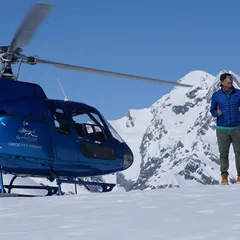
Cheapest flightSnow landing
20 min20-Minute Snow Landing
★ 4.9 · 56 reviews
- 20 minutes, above ice falls and crevasses
- Franz Josef Glacier from the air
- Cheapest here
- Free cancellation
$213$639.00 / hour
Check availability→ The scales at check-in
You will be weighed at check-in, in front of everybody else on your flight, and the number decides where you sit. This is not a policy anyone enjoys and it is not negotiable: a five-seat helicopter has to be balanced, and the only way to balance it is to know what is in each seat. Here is exactly how the Franz Josef helicopter weight limits work, what happens above them, and what to say when you book.
Quick answer
The short answer. Rear seats are typically capped around 120 kg and front seats lower, often around 85 kg, because of where the weight sits in the airframe. Above the seat limit you are asked to buy a comfort seat at roughly half the flight price. Declare your weight when you book, not at the scales, and none of this becomes awkward.
Why they weigh you
The scales are an aircraft instrument, not a doorman.
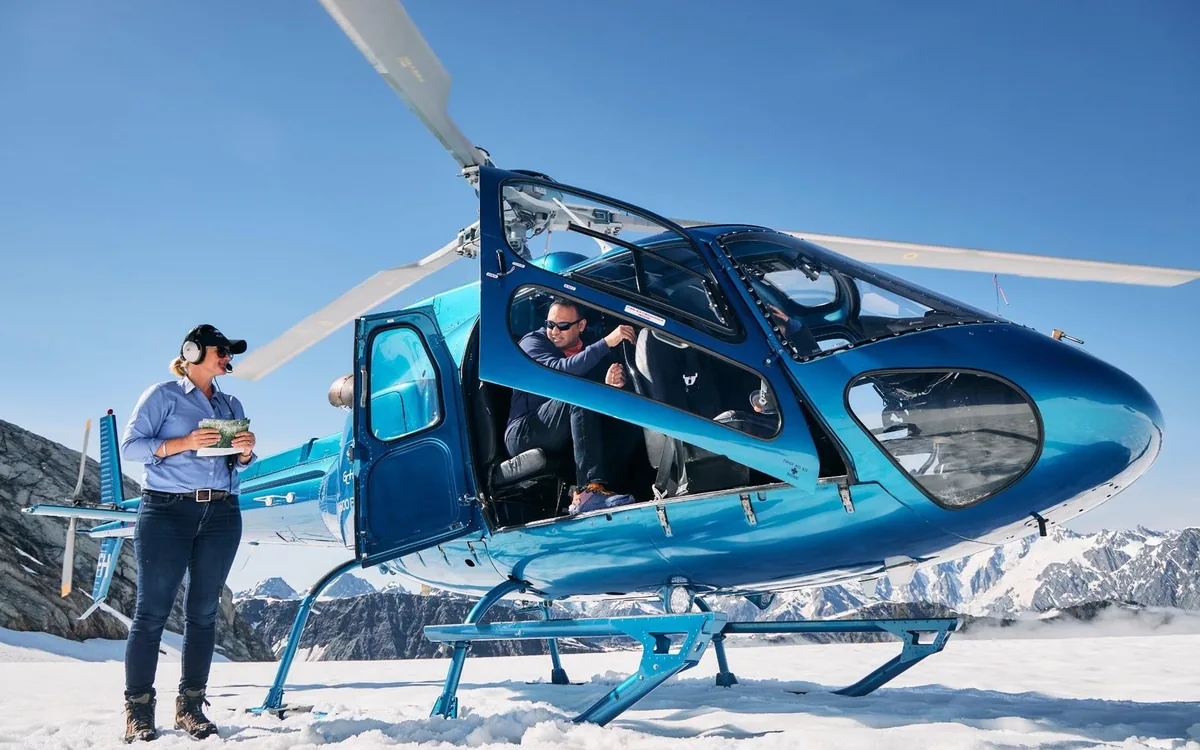
A light helicopter is a small machine with a narrow envelope. Total weight matters, but where the weight sits matters more: too much forward and the machine handles badly on the approach, too much on one side and it flies out of trim all day. On a five-seat aircraft, one passenger in the wrong seat is a meaningful proportion of the whole.
So the manifest is built from the scales. The heaviest passengers usually go in the rear, the front seat is often capped lower than the back ones, and the pilot allocates seats after everyone has checked in. This is why you cannot choose a side however early you booked, and why the answer to “can I sit in the front?” is almost always “we will see at check-in”.
None of it is a comment on you. The person doing the weighing does it forty times a day and has forgotten your number by the time you are on the pad.
If you are over the limit
Every one of these is easier before you arrive than at the desk.
Operators handle this constantly and none of them will make it strange. Declaring in advance gets you a seat allocation that works and a price you know, instead of a conversation in front of a queue.
Above the seat limit the standard answer is to buy an additional seat at roughly half the flight price. You are not being turned away; you are buying the space the aircraft needs.
Limits differ between operators and between aircraft types. A number that requires a comfort seat on one machine may be inside the rear-seat limit on another. It is a fair question and they will answer it.
Every flight needs at least two passengers. If you are travelling alone and buying a comfort seat, ask whether that counts towards the minimum or whether you will still be paired with someone.
Booking a guided walk on the ice rather than a scenic flight? The weight rules there are tighter, because of the harness.
Landings and what they involve→Other limits
Height. There is no published height limit on a scenic flight. Tall passengers are usually put in the front, where there is more legroom, which is a rare case of the manifest working in your favour.
Age. Operators differ. Infants on a lap are generally not permitted because every passenger needs a seat and a belt, and most operators want children old enough to keep a headset on. Check the specific listing rather than assuming.
Mobility. Getting into the machine involves a step up and a duck under a rotor disc. Operators are used to helping and will tell you honestly whether a particular flight works. Ring rather than book blind.
Two-person minimum. Not a weight rule, but the one that most often changes a plan. Single bookings are accepted and paired with other passengers. Usually you never notice; occasionally it means being moved to a later slot, which is one more reason not to book the hour before your bus leaves.
Book direct
The same weigh-in applies to all of them.
★ 4.9 · 56 reviews
★ 4.8 · 693 reviews
★ 4.9 · 527 reviews
Common questions
Yes. Rear seats are typically capped around 120 kg and front seats lower, often near 85 kg, because of aircraft balance. Above the seat limit you buy a comfort seat at roughly half the flight price. Absolute limits are usually around 155 kg.
Yes, at check-in, on every flight. Seats are allocated from the manifest so the machine flies in trim. It is routine and it takes ten seconds.
An additional seat bought at roughly half the flight price when a passenger is over the standard seat limit. It is a balance requirement rather than a penalty, and declaring your weight at booking makes the cost predictable.
No. Seats are allocated by weight after everyone has checked in. The consolation is that these machines have no middle seats, so everybody is against a window.
Yes, and it is lower — typically around 115 kg including harness and gear, because you are walking on the ice in equipment rather than sitting in a seat. Scenic flights have the more generous limits.
No, but every flight needs at least two passengers, so a single booking is paired with another. That usually happens invisibly. Occasionally it means moving to a later departure, so leave some slack in the day.
Go deeper
Twelve helicopter flights out of one village, from twenty minutes to ninety.
PricesTwelve flights priced per person and per minute, and where the money actually goes.
VerdictTwelve flights ranked for one decision, with a straight answer at the end.
LandingsWhich flights actually put the machine down, and what the difference is.
LengthThe only real variable, and how much country each length buys you.
Which oneTwo glaciers, twenty-five minutes apart, and the flights that show you both.