Our top pickMost reviewed
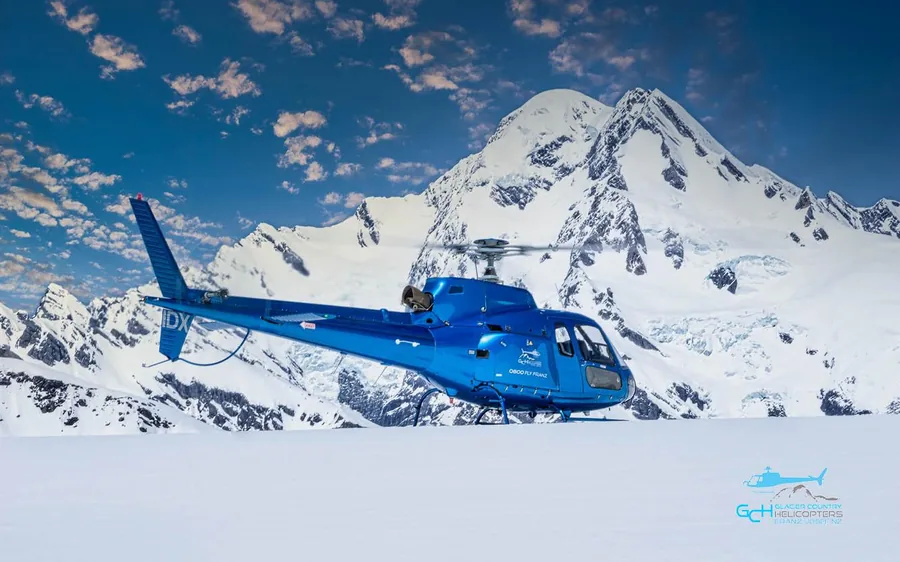
25 min25-Minute Alpine Landing
★ 4.8 · 693 reviews
- 25 minutes, above Franz Josef Glacier
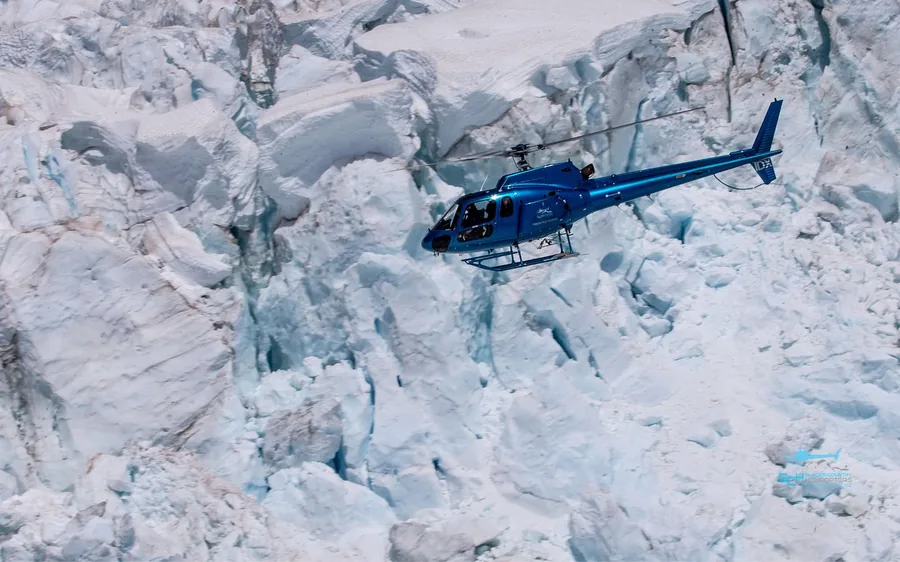
- Ice pinnacles and crevasses
- Most booked
- Free cancellation
$219$525.60 / hour
Check availability→ Out of the window
Operator copy says “spectacular alpine scenery”. That is true and it is useless. This page describes what is genuinely under the window on a Franz Josef helicopter flight, in the order you see it, from the braided riverbed at the start to the moment the icefall arrives and everybody stops talking. It also says which side to sit on and what your photographs will and will not come out like.
Quick answer
The short answer. A grey braided riverbed, four minutes of rainforest walls, then an icefall that arrives all at once as a wall of blue-white blocks the size of houses, then a white basin ringed by peaks, then ten minutes standing in silence on snow. The icefall is the part people remember. The silence is the part they talk about afterwards.
The first five minutes
The oddest thing about Franz Josef, and the thing photographs never convey, is how low the ice comes and what it comes down into. The village sits at about a hundred and fifty metres above sea level in temperate rainforest — tree ferns, moss, rata. Thirteen hundred metres above that, and five kilometres away, there is a glacier.
You lift off and the first thing under you is the Waiho riverbed: a wide grey braid of gravel with a river in it that looks far too small for the channel it occupies. That discrepancy is the whole story of this valley. The riverbed was carved by something much bigger than the water currently running through it.
Then the walls close in and the machine climbs hard, and for three or four minutes you are looking at rainforest going past sideways at a speed it should not be going past at.
The icefall
The icefall is the reason the flight exists. Everything else is context.
There is a moment, somewhere around minute five, when the trees end and the ice starts, and it does not fade in gradually. It arrives.
The Franz Josef icefall is the steepest section of the glacier, where the ice pours over a break in the bedrock and shatters. From two hundred metres above it you are looking at blocks the size of houses, tilted at angles that do not look stable, split by crevasses with blue light coming out of the bottom of them. The blue is real and it is not the sky — it is what happens to light in ice dense enough to have had every bubble squeezed out of it.
Nobody talks during this part. Every pilot on this coast will tell you the same thing: the headsets go quiet at the icefall.
Above it the glacier flattens out into the névé, a vast white basin ringed by peaks, and the whole machine suddenly makes sense. Snow collects up here. It compacts, it flows, and it comes apart down there.
Practical
Small decisions that change what you come home with.
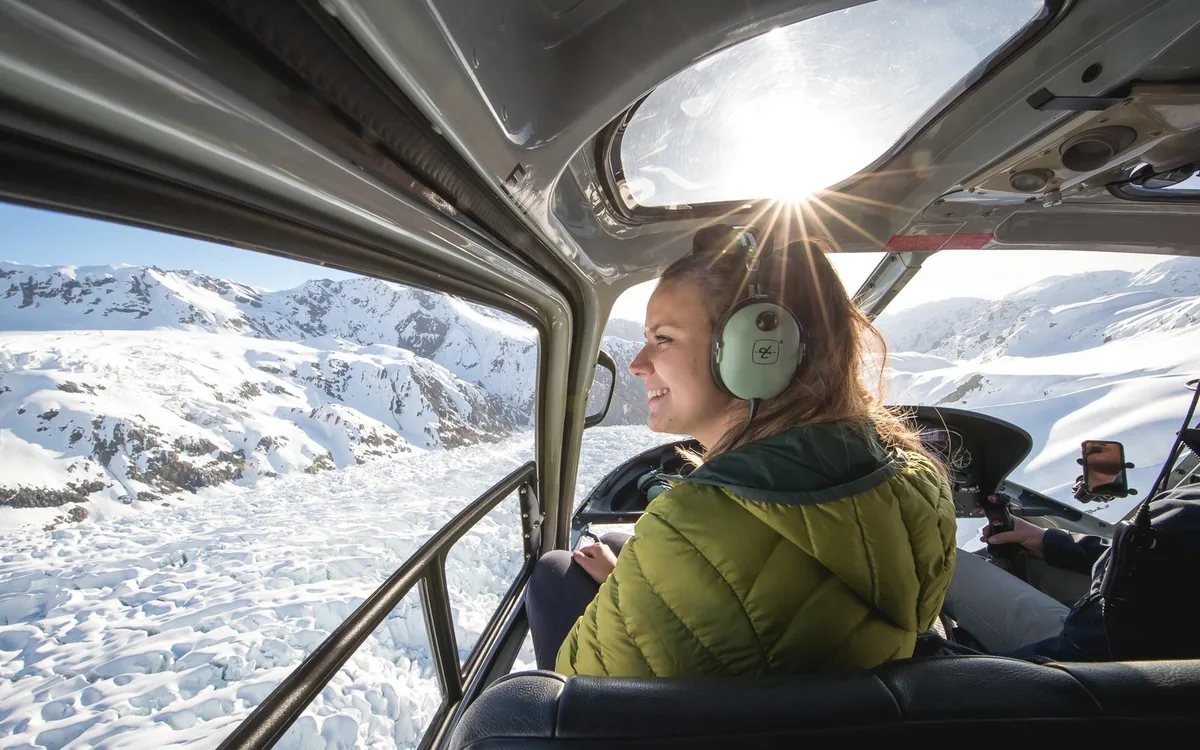
These are five- and six-seat machines and everybody is against a window. Seats are allocated by weight for balance, not by preference, so there is no point asking for a side — but there is also no bad seat.
On a morning flight the sun is behind you going up the valley. The shaded side of the cabin gives you cleaner glass and no reflections in the photographs.
Shooting through curved perspex with a polarising filter produces rainbow banding that cannot be removed afterwards. Take it off, keep the lens close to the glass without touching it, and shoot wide.
Everybody comes home with pictures of white and blue that look like an aerial texture. The shots that work are the ones with the machine, a person, or a ridge line in them for scale. Use the ten minutes on the ground for those.
The glare off fresh snow at two thousand metres is severe enough to hurt within a couple of minutes. A warm layer is comfort; eye protection is not optional.
These are not doors-off photography flights. The windows are large, they are clean, and on most machines the front seats have a section that opens on the ground for the landing shots.
Wondering what the ten minutes standing on the ice are actually like?
Snow and alpine landings→On the longer flights
Everything above happens on a twenty or twenty-five minute flight. Buy more minutes and here is what appears.
Thirty minutes: the Tasman side. The machine crosses the Main Divide and you get Aoraki Mount Cook — three thousand seven hundred and twenty-four metres, the highest mountain in the country — from close enough that it stops being a postcard.
Thirty-five minutes: Fox Glacier, over a low saddle to the south. Longer, flatter and easier to read as a single object than Franz Josef.
Forty-five minutes: three glaciers, including the head of the Tasman — at around twenty-three kilometres, the longest glacier in New Zealand and a completely different kind of landscape from the icefall you started over.
One hour and beyond: two landings in two different places, and the Southern Alps as a range rather than as a wall you flew up to.
Book direct
Franz Josef alone, the Tasman side, both glaciers, and three glaciers in one flight.
★ 4.8 · 693 reviews
★ 4.8 · 84 reviews
★ 4.9 · 527 reviews
★ 4.8 · 164 reviews
Common questions
The braided Waiho riverbed, four minutes of rainforest valley walls, then the icefall — blocks of blue-white ice the size of houses split by deep crevasses — then the névé basin above it, and then ten minutes standing on snow at fifteen hundred metres or more.
Yes. Glacier ice has had almost all the air squeezed out of it, and dense ice absorbs red light and scatters blue. The colour is strongest deep in the crevasses, which is exactly where you are looking from a helicopter.
There is no bad seat. These are five- or six-seat machines and everybody is against a window. Seats are allocated by weight to balance the aircraft, so you cannot choose — but on a morning flight the shaded side gives cleaner photographs.
On the shorter flights, only as a shape on the horizon. Flights of thirty minutes or more cross the Main Divide and give you Aoraki Mount Cook properly, along with the Tasman Glacier.
No. These are standard scenic flights with the doors on and large clean windows. Take any polarising filter off your lens before you fly — shooting through curved perspex with one produces banding you cannot fix afterwards.
Yes, and everyone wears a headset with the pilot’s commentary on it. The part people remember is the opposite: at the landing the turbine is shut down completely, and the silence on the snow is total.
Go deeper
Twelve helicopter flights out of one village, from twenty minutes to ninety.
PricesTwelve flights priced per person and per minute, and where the money actually goes.
VerdictTwelve flights ranked for one decision, with a straight answer at the end.
LandingsWhich flights actually put the machine down, and what the difference is.
LengthThe only real variable, and how much country each length buys you.
Which oneTwo glaciers, twenty-five minutes apart, and the flights that show you both.